BMI Calculator
Calculate your Body Mass Index and see where you fall on the WHO scale.
Your Measurements
Want More?
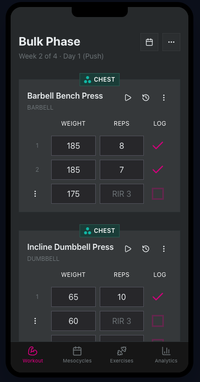
Mesostrength tracks your training volume and adjusts your program based on real progress, not just a number on a scale.
Auto-Adjusted Volume
Weekly sets adapt based on your progress and recovery signals.
Structured Mesocycles
Complete training blocks with progressive overload and planned deloads.
Smart Progression
Automatic weight and rep prescriptions every session.
Fatigue Management
Built-in deload timing that prevents overtraining before it starts.
Performance Analytics
Track strength trends, volume history, and muscle group balance.
Personalized Programming
Every variable tailored to your experience, goals, and recovery.


Understanding BMI for Lifters
Body Mass Index is a simple ratio of weight to height squared. It was designed for population-level health screening, not individual fitness assessment. For strength athletes and regular lifters, BMI has well-known blind spots, but it still serves a purpose when interpreted correctly.
Why BMI Matters (and Where It Fails)
BMI is useful as a quick health screening tool because extreme values (very high or very low) do correlate with health risks across large populations. However, it cannot tell the difference between 100kg of muscle and 100kg of fat. A lean, muscular lifter at 90kg and 175cm will have a BMI of 29.4 (overweight), which is misleading. That is why body fat percentage is a far better measure of body composition for anyone who trains seriously.
When to Use BMI vs Body Fat Percentage
- Use BMI as a starting point if you do not know your body fat percentage. It is better than nothing for general health awareness.
- Use body fat % for any decision about cutting, bulking, or adjusting your nutrition. It tells you what your weight is actually made of.
- Use both together to get the full picture. A high BMI with a low body fat percentage means you carry significant muscle mass, which is not a health concern.
The BMI Formula
BMI equals your weight in kilograms divided by your height in meters squared. For example, an 80kg person at 1.75m tall has a BMI of 80 / (1.75 x 1.75) = 26.1. The WHO classifies BMI under 18.5 as underweight, 18.5 to 24.9 as normal, 25 to 29.9 as overweight, and 30 or above as obese (with three severity classes).
Frequently Asked Questions
Mesostrength plans your training for you.
Mesostrength is an app for people who want to build muscle. It tells you what to lift each week. It uses your logged workouts and recovery to adjust your sets and weights. This calculator does one piece of that. The app does all of it, automatically.