Muscle Symmetry Checker
Compare left and right measurements to identify imbalances and proportion issues.
Left vs Right Measurements
Measure each muscle group on both sides. Leave blank any you want to skip.
Upper Arm (bicep)
Forearm
Thigh (quad)
Calf
Proportional Measurements
These measure overall body proportions. Fill in at least shoulders and waist for ratio analysis.
Want More?
Mesostrength lets you prioritize lagging sides with targeted volume adjustments in your program.
Auto-Adjusted Volume
Weekly sets adapt based on your progress and recovery signals.
Structured Mesocycles
Complete training blocks with progressive overload and planned deloads.
Smart Progression
Automatic weight and rep prescriptions every session.
Fatigue Management
Built-in deload timing that prevents overtraining before it starts.
Performance Analytics
Track strength trends, volume history, and muscle group balance.
Personalized Programming
Every variable tailored to your experience, goals, and recovery.


Muscle Symmetry and Proportional Balance
Muscle symmetry has both aesthetic and functional significance. Left to right imbalances can increase injury risk, while overall proportional balance affects how your physique looks. Regularly checking your measurements helps you identify and address weak points before they become problems.
Left vs Right Asymmetry
Some left-right difference is completely normal. Most people have a dominant side that is slightly larger and stronger. Differences under 3% are considered balanced and require no special attention. Between 3% and 10%, the imbalance is minor but worth monitoring over time. Above 10%, the asymmetry is significant and may warrant targeted unilateral training to bring the weaker side up. Unilateral exercises like single-arm rows, lunges, and dumbbell presses are the primary tool for correcting side-to-side imbalances.
Classic Proportional Ratios
The shoulder-to-waist ratio is the most impactful proportion for visual aesthetics. The classic ideal is around 1.618 (the golden ratio), where shoulder circumference is roughly 1.6 times waist circumference. The chest-to-waist ratio of approximately 1.4 and shoulder-to-hip ratio of about 1.35 also contribute to a balanced appearance. These are guidelines, not rigid rules. Genetics play a significant role in your natural proportions, and working toward better ratios is more productive than obsessing over exact numbers.
How to Measure Accurately
Use a flexible cloth tape measure. Measure at the widest point of each muscle group, keeping the tape level and snug but not tight. Measure both sides in the same position (arm hanging relaxed, or flexed if you prefer, but be consistent). Take measurements at the same time of day, ideally in the morning before training and eating. Track measurements every 4 to 8 weeks to see meaningful changes.
Frequently Asked Questions
Mesostrength plans your training for you.
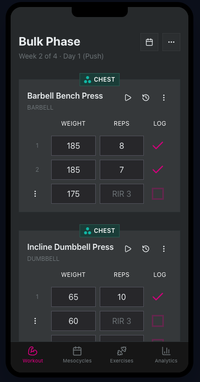
Mesostrength is an app for people who want to build muscle. It tells you what to lift each week. It uses your logged workouts and recovery to adjust your sets and weights. This calculator does one piece of that. The app does all of it, automatically.