Gym Session Length Optimizer
Fit the best possible workout into your available time with smart exercise prioritization.
Session Parameters
Muscle Groups to Train
Training Goal
Exercise Preference
Want More?
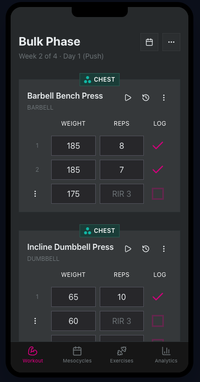
Mesostrength builds time-optimized workouts that fit your schedule and hit every muscle group.
Auto-Adjusted Volume
Weekly sets adapt based on your progress and recovery signals.
Structured Mesocycles
Complete training blocks with progressive overload and planned deloads.
Smart Progression
Automatic weight and rep prescriptions every session.
Fatigue Management
Built-in deload timing that prevents overtraining before it starts.
Performance Analytics
Track strength trends, volume history, and muscle group balance.
Personalized Programming
Every variable tailored to your experience, goals, and recovery.


Optimizing Your Gym Session Length
Time is often the biggest constraint for gym-goers. Knowing how to structure a session around your available time, without sacrificing the exercises that matter most, can mean the difference between a productive workout and a wasted one. The goal is not to cram everything in but to prioritize what delivers the most value.
Compounds First, Always
Compound movements (squats, bench press, rows, deadlifts, overhead press) should always take priority in a time-limited session. They train multiple muscle groups at once, produce the greatest mechanical tension, and drive the most overall adaptation per minute invested. If time is tight, a session of three to four compound exercises with adequate sets is far more effective than rushing through eight exercises with poor effort.
Rest Periods by Goal
Rest periods are the biggest time variable you can control. Strength training requires 2 to 3 minutes between heavy compound sets to allow full ATP regeneration. Hypertrophy work can use shorter rest of 90 seconds to 2 minutes. General fitness allows 60 to 90 seconds. Shortening rest periods beyond these ranges saves time but reduces performance on subsequent sets. If you must cut time, it is usually better to drop an exercise than to slash rest periods below optimal ranges.
Time-Saving Strategies
Supersets (pairing non-competing exercises) can cut session time by 30 to 40% without significantly impacting performance. For example, pair bench press with rows, or squats with pull-ups. Another strategy is straight sets with timed rest: start a stopwatch after each set and begin the next set right when rest is up. Avoid unnecessary warm-up sets for later exercises if those muscles were already activated by earlier compounds. A 5 to 10 minute general warm-up followed by 1 to 2 ramp-up sets on your first exercise is sufficient for most people.
Frequently Asked Questions
Mesostrength plans your training for you.
Mesostrength is an app for people who want to build muscle. It tells you what to lift each week. It uses your logged workouts and recovery to adjust your sets and weights. This calculator does one piece of that. The app does all of it, automatically.