Wilks Score Calculator
Calculate your Wilks score to compare relative strength across body weights.
Your Details
Sex
Enter Your Lifts
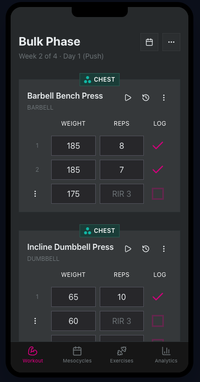
Want More?
Mesostrength tracks your estimated totals and relative strength over time.
Auto-Adjusted Volume
Weekly sets adapt based on your progress and recovery signals.
Structured Mesocycles
Complete training blocks with progressive overload and planned deloads.
Smart Progression
Automatic weight and rep prescriptions every session.
Fatigue Management
Built-in deload timing that prevents overtraining before it starts.
Performance Analytics
Track strength trends, volume history, and muscle group balance.
Personalized Programming
Every variable tailored to your experience, goals, and recovery.


The Wilks Score Explained
The Wilks score is a formula used in competitive powerlifting to compare lifters across different body weights. It normalizes your powerlifting total (squat + bench press + deadlift) relative to your body weight using a polynomial equation, producing a single number that allows fair comparison between a 60 kg lifter and a 120 kg lifter.
How the Formula Works
The Wilks formula uses a fifth-degree polynomial to create a coefficient based on body weight. This coefficient is multiplied by your total to produce the Wilks score. Separate sets of coefficients are used for male and female lifters because the relationship between body weight and strength potential differs between sexes. The formula was developed by Robert Wilks and has been the standard comparison method in the International Powerlifting Federation for decades.
Interpreting Your Score
General benchmarks for Wilks scores:
- Under 150 - Beginning stages of training
- 150-250 - Novice level, consistent training is paying off
- 250-350 - Intermediate, a solid base of strength
- 350-450 - Advanced, competitive at local and regional meets
- 450+ - Elite, competitive at national and international level
Limitations to Keep in Mind
The Wilks formula tends to slightly favor middle-weight lifters and may not perfectly normalize at extreme body weights. Alternative formulas like DOTS and IPF GL Points have been developed to address these limitations. However, Wilks remains the most widely recognized and used coefficient in the sport, making it the standard reference point for comparing powerlifting performance.
Frequently Asked Questions
Mesostrength plans your training for you.
Mesostrength is an app for people who want to build muscle. It tells you what to lift each week. It uses your logged workouts and recovery to adjust your sets and weights. This calculator does one piece of that. The app does all of it, automatically.